
When firefighters arrive, the fire already has the upper hand. Every breath, every second, every move matters. What appears to be chaos from the street is, in fact, a carefully choreographed battle with heat, smoke, and time.
From the moment the first engine pulls up, the crew’s world changes. Visibility drops to inches. The air is too toxic to breathe. Temperatures can exceed 1,000 degrees Fahrenheit near the ceiling. What you smell outside—burnt plastic, wood, insulation—is the safe version. Inside, that smoke can kill in minutes.
The View From the Doorway
The first firefighter through the door crawls low, feeling along the floor for victims and finding their way by touch. The mask muffles sound—the radio crackles. The room is dark—pitch black, not the kind of darkness you see in a movie. Even flashlights struggle to cut through the haze.
Every move is methodical: right-hand search, sweep, advance, communicate. They can’t see what’s burning, only that heat and smoke push harder the deeper they go. They stay low because the air above their heads could ignite if disturbed.
What We Look For First
Lives come before property. Always. Firefighters enter with a single goal—to get anyone still inside out alive. That means searching bedrooms, hallways, bathrooms, and closets, often guided only by instinct and training. A bedroom door closed before the fire started might be cool to the touch—behind it could be breathable air and a survivor.
Research from the U.S. Fire Administration shows that closed doors can keep temperatures ten times lower and limit the spread of toxic gases. That’s why firefighters check every door before forcing it open—one mistake can flash a room into flames.
Why Running Back Inside Is Deadly
Once you escape, stay out. Running back inside for a phone, pet, or heirloom turns seconds into a death sentence. Smoke thickens faster than you think—it takes less than two minutes for a small fire to become deadly. Heat burns lungs before flames touch skin. Even firefighters in full gear can’t last long without access to water.
We’ve seen it too many times—someone re-enters, disappears into smoke, and never comes back out. No possession is worth that risk. Firefighters are trained to go in for rescues. You aren’t. Your job is to stay safe, stay out, and tell us who and what’s inside.
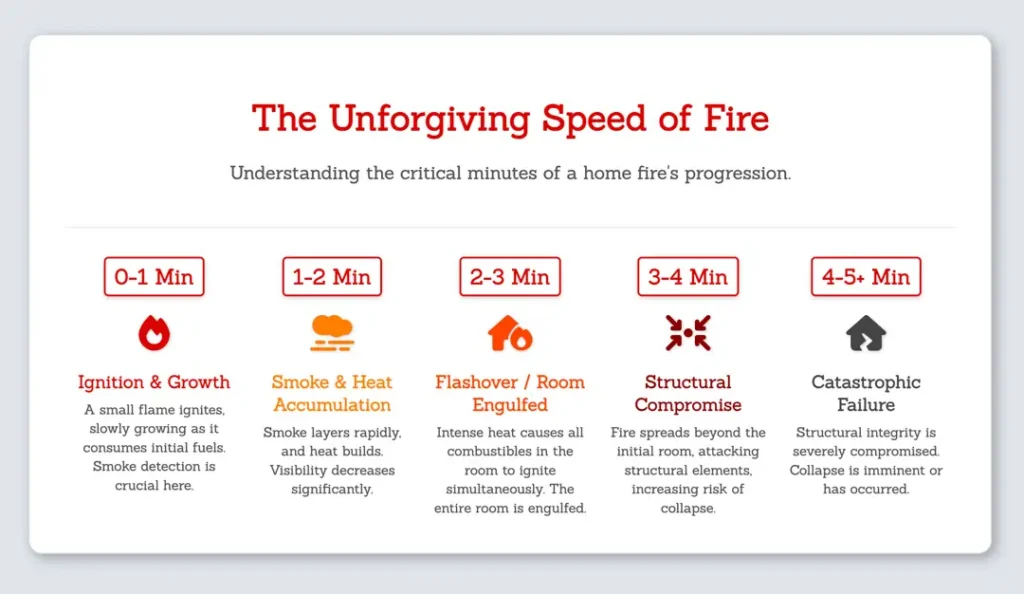
Inside the Fireline: A Minute-by-Minute Glimpse
| Minute | Inside the Fire | Outside the Home |
|---|---|---|
| 1 | Firefighters advance from the entry point, checking for trapped occupants. Heat and visibility worsen. | Neighbors gather. Homeowner shouts details—pets, family, hazards. |
| 2 | Ceiling gas layer hits ignition temperature. The crew uses a fog stream to cool and push back the flames. | The hose team charges the line; the second crew prepares for ventilation. |
| 3–4 | Search continues through the rooms. Furniture and plastics release cyanide and carbon monoxide. | Incident command confirms water supply and accounts for all crew positions. |
| 5+ | Conditions shift. The floor may weaken. Firefighters retreat, regroup, and attack from the exterior if the collapse poses a threat. | EMS prepares for victims or firefighter rehab—operation transitions to overhaul and investigation. |
What Firefighters Wish Every Family Knew
- Get out fast and stay out. Never re-enter a burning home.
- Close bedroom doors before sleeping—this can save lives in the event of a fire.
- Meet at a designated landmark (e.g., mailbox, tree) for accountability.
- Inform firefighters immediately if someone or a pet is still inside and provide their last known location.
- Post visible house numbers for faster identification at night.
When the Smoke Clears
When the fire’s out, the house looks nothing like what you remember. Black soot covers everything. Water pools across the floor. What was once home now smells like chemicals and ash. But every intact wall, every unburned room, means the tactics worked. You called early. You got out. You gave firefighters a fighting chance to save what mattered most.
Community Support: The Independence Volunteer Fire Department provides fire education, home safety visits, and free smoke alarm installations. To learn how to prepare your family and reduce fire risks, visit the station or contact us through the Town of Independence website.
Sources: USFA, NFPA, NIST Fire Research Division.